Dynamic Programming Explained: The Missing Link with Divide & Conquer
-
 Jason Yang
 - 01 Dec, 2025
- Updated 04 Jan, 2026
- Views —
Dynamic Programming (DP) often intimidates developers, but in reality, it’s nothing mysterious.
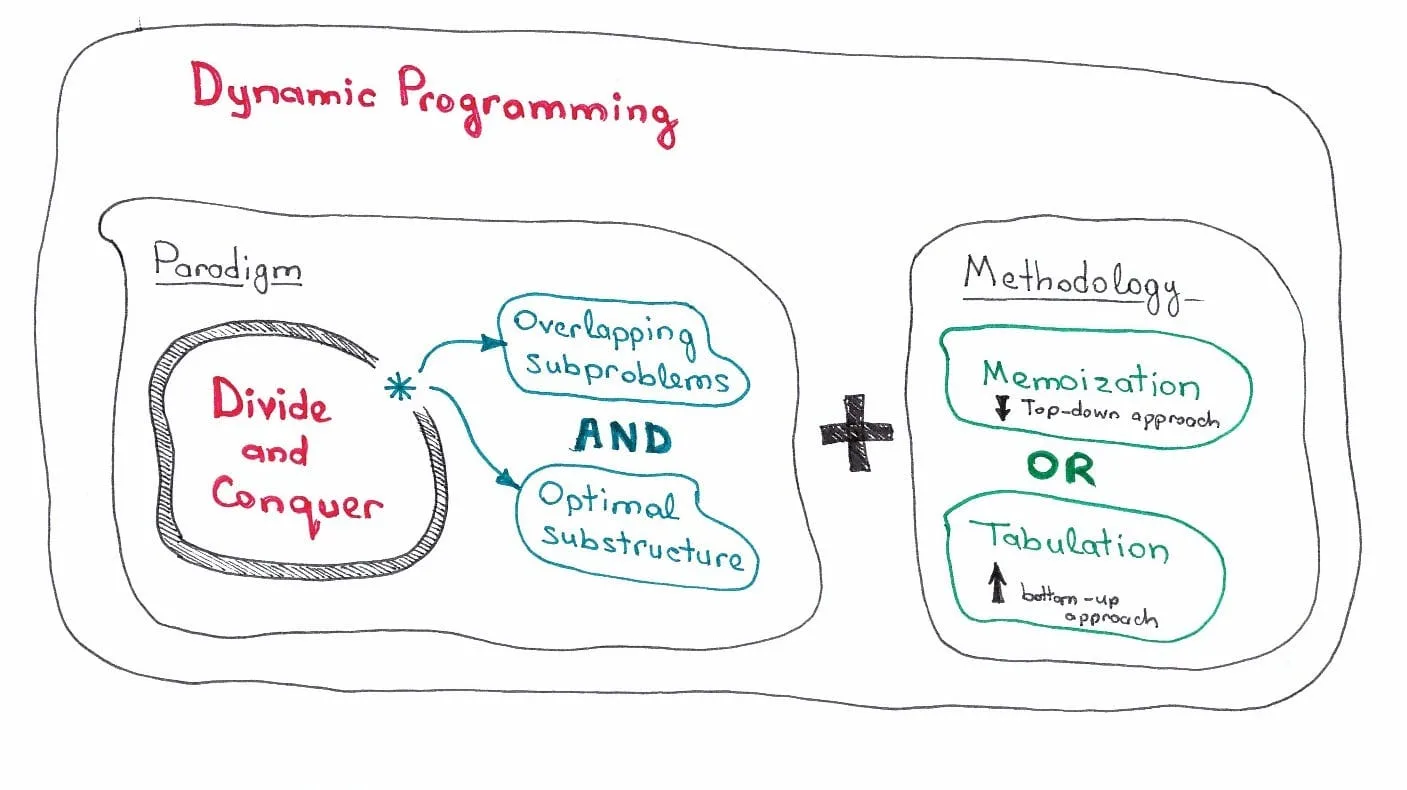
DP is simply Divide and Conquer enhanced with memory.
Once you see this connection clearly, DP becomes predictable, logical, and easy to explain during interviews.
This post breaks down DP through its relationship with Divide & Conquer (D&C) so you can understand — and articulate — exactly when and why DP is needed.
1. DP’s Core Equation
The easiest way to understand DP is by comparing it with Divide & Conquer.
Divide & Conquer
- Split a problem into subproblems
- Subproblems are independent (no overlap)
- Example: Merge Sort, Quick Sort
Sorting the left array never affects sorting the right array.
No repeated work exists.
Dynamic Programming
- Split a problem into subproblems
- Subproblems overlap
- Same input is solved repeatedly → wasteful
- Add memory (caching) to avoid recalculating
⭐ The Formula
DP = Divide & Conquer + Overlapping Subproblems + Caching
This single act of storing results changes the time complexity from exponential () to linear or polynomial.
2. Conditions for Using Dynamic Programming
When an interviewer asks:
“Why does this problem require DP?”
you only need two keywords:
1) Optimal Substructure
The optimal solution can be built from the optimal solutions of its subproblems.
2) Overlapping Subproblems
The same subproblem occurs repeatedly.
Examples:
- D&C (no overlap) →
sort([1,2])andsort([3,4])are unrelated. - DP (overlap) → Fibonacci repeatedly calls
fib(3)andfib(2).
Other classic DP problems with overlapping subproblems:
- Knapsack
- Longest Increasing Subsequence (LIS)
- Coin Change
- Edit Distance
3. DP Implementation Patterns
DP is implemented in two strategies with opposite thinking directions.
Memoization (Top-down)
“The smart lazy approach.”
- Start from the main problem
- Recursively break it down
- Store results of subproblems
- Pure Divide & Conquer + caching
- Easy to write, great for clarity
Tabulation (Bottom-up)
“The diligent builder approach.”
- Start from base cases
- Iteratively build the solution
- No recursion overhead
- Usually faster in practice
4. Why Divide & Conquer Thinking Wins in Interviews
Most candidates panic and draw DP tables too early.
Successful candidates take this path:
- Try solving recursively using D&C
(“Can I break this into smaller subproblems?”) - Examine the recursion tree
(“Wait… these calculations repeat.”) - Optimize using DP
(“Let me cache results to eliminate overlaps.”)
This is the clearest and most logical interview explanation.
Interview Tip
Use this line:
“I first analyzed the problem using a divide-and-conquer perspective to understand the recursive structure. While examining the recursion tree, I noticed overlapping subproblems, so I optimized it using DP with memoization to reduce the time complexity.”
This answer leaves a strong impression of structured, senior-level thinking.
5. Summary (Interview Cheat Sheet)
- DP = Divide & Conquer + Memory
- Use DP when optimal substructure and overlapping subproblems exist.
- Caching reduces complexity from ** → O(n) or polynomial.
- Interview flow: Recursion → Overlaps → DP Optimization
Once the idea clicks, the next skill is finding the recurrence quickly under pressure. For a recipe plus the 1D DP problems grouped by recurrence shape, see Dynamic Programming Patterns: Finding the Recurrence.